 |
| Source: Amazon |
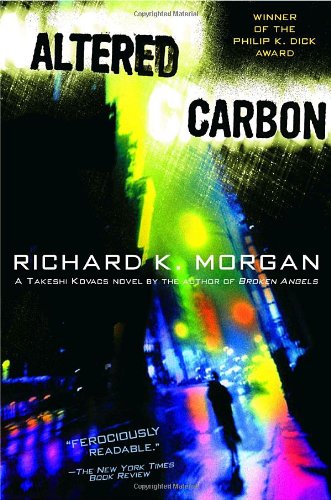
I just finished reading Altered Carbon by Richard K. Morgan. It is a cyberpunk murder mystery set far in the future, in a universe where people can digitally move their minds into different bodies. For interstellar travel, they have a way to instantly transmit their minds into new bodies on other planets.
The main character is Takeshi Kovacs (the "cs" is pronounced like a "ch). Kovacs is a former Envoy, a kind of supersoldier/spy trained to fight in any body. He also has an almost perfect memory, as well as the ability to set aside emotions and think rationally whenever he chooses to.
How are real-world humans anything like Kovacs? He is an extreme case of the struggle between reason and emotion that goes on inside us all. Kovacs was abused as a child, abused in his military training, and forced to commit atrocities in war while his friends died painfully all around him. At heart, he is a traumatized person who wants to make the world a better place so that others will not suffer as he has. Balancing his desire for a better world is his rigid conditioning, which periodically trickles through him like cold water, turning him into a highly intelligent investigative killing machine.
Most of us here in the real world have been through less trauma. We are able to use logic, but we don't turn into human machines. We do, however, sometimes have to choose between our feelings and our logic. Like Kovacs, we can't always follow our hearts.
Kovacs often thinks back to something his commanding officer once said: “In the Envoy Corps, you take what is offered. And that must sometimes be enough.” For Kovacs, this means that he follows his heart when he can, leading to everything from steamy sex scenes to bids for revenge to acts of kindness.
In our own lives, we should also follow our hearts. I don't recommend having a fight to the death in the name of vengeance, but the world could certainly use more acts of kindness, not to mention more steamy sex scenes.


